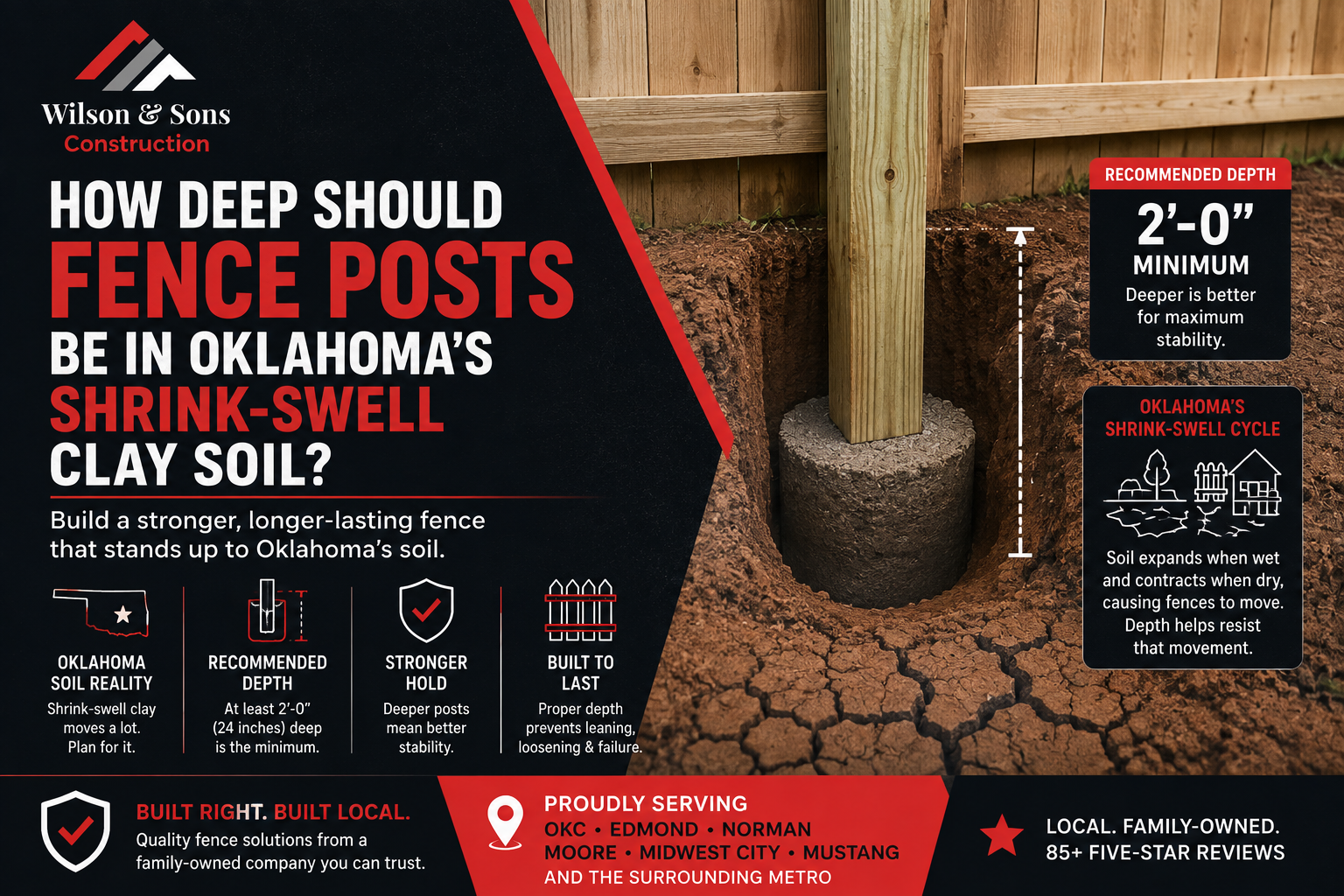
How Deep Should Fence Posts Be in Oklahoma’s Shrink-Swell Clay Soil?
For a 6-foot privacy fence in Oklahoma’s shrink-swell clay soil, fence posts should be set a minimum of 36 to 42 inches deep — significantly deeper than the national standard depth of approximately 24 inches — to prevent the heaving, tilting, and frost upheaval that Oklahoma’s wet-dry soil cycles cause.
That is the answer most Oklahoma homeowners and contractors need when they start planning a fence project in the OKC metro or surrounding counties. The national “one-third of the post in the ground” rule is a reasonable starting point for stable soils in temperate climates — but it underestimates what Oklahoma’s clay does to shallow-set fence posts. This guide explains why the depth requirement is different here, how to calculate the right depth for your fence height, and what to do about concrete footings in soil that expands and contracts as much as Oklahoma’s does.
Why Oklahoma Clay Is Different
Oklahoma’s soils include significant concentrations of expansive clay across the OKC metro and much of the state. The scientific classification for this soil type is “shrink-swell” clay — a name that accurately describes what the material does. When the soil absorbs water, it swells in volume. When it dries out, it contracts. The volumetric change between the two states is not trivial: expansive clays in Oklahoma can change in volume by 10 to 30 percent between their wet and dry conditions.
Oklahoma’s climate is close to the worst possible environment for shrink-swell clay. Wet springs — with average annual rainfall of 36 or more inches, much of it arriving in concentrated spring storm bursts — saturate the clay and drive maximum swelling. Then summer temperatures regularly exceed 100°F and the surface soil desiccates rapidly, pulling the clay back through its full contraction cycle. This wet-dry cycling repeats year after year, and every cycle applies upward and lateral pressure to anything anchored in the soil — including fence posts.
Oklahoma’s expansive clay soils can change in volume by 10-30% between wet and dry states. A fence post anchored only 24 inches deep in this soil can be heaved 1-3 inches upward during a wet spring — enough to tilt or loosen even a properly installed panel.
The areas most affected in the OKC metro are extensive. Oklahoma County, Canadian County, and Cleveland County all have significant shrink-swell soil presence. The OKC metro sits on some of the state’s highest-plasticity clay deposits — meaning the clay in this area has above-average volumetric change potential compared to clay soils elsewhere in the country. A fence post depth that performs well in, say, Georgia or Ohio will frequently fail in Oklahoma.
The Depth Formula for Oklahoma Fences
The standard national rule for fence post depth is one-third of the post length in the ground. For a fence that stands 6 feet above grade, this suggests using an 8-foot post and setting it 24 inches deep. In stable loam or sandy soils in a moderate climate, this is a reasonable specification. In Oklahoma’s clay, it is consistently inadequate.
The Oklahoma-modified rule for clay soil is: set posts a minimum of 36 to 42 inches for a 6-foot fence. For heavier fence styles — particularly board-on-board (shadow box) panels, which are popular in Oklahoma subdivisions and create more wind load than standard dog-ear privacy panels — 42 inches is the more conservative and appropriate minimum. This requires longer posts than the national standard calls for.
The post length math for common Oklahoma fence heights:
- 6-foot fence: Use 9-foot or 10-foot posts. Set 36-42 inches below grade, leaving 6 feet of post above the ground surface. A 9-foot post set 36 inches deep gives exactly 6 feet of height; a 10-foot post set 42 inches deep gives the same result with the more conservative depth.
- 8-foot fence: Use 12-foot posts. Set 42-48 inches below grade, leaving 8 feet of post above grade.
Oklahoma fence rule: for every 1 foot of fence height, plan for at least 6 inches of post depth beyond the national standard. For a 6-foot fence in clay soil, that means 36 inches minimum — not the 24 inches you will often see recommended in national guides.
The additional post length does add to material cost, but the cost difference between a 8-foot post and a 10-foot post is small compared to the labor cost of resetting posts that have heaved or tilted after one or two Oklahoma spring cycles.
Concrete Footings in Oklahoma Clay — Yes or No?
This question generates genuine debate among Oklahoma fence contractors, and the honest answer is that it depends on the approach taken. Concrete footings are not universally better in Oklahoma’s clay soil — and in some configurations, they can make the problem worse rather than better.
In standard stable soil, a concrete tube footing (a straight-sided cylinder of concrete poured around the post base) provides excellent anchor strength. In Oklahoma’s shrink-swell clay, the problem is that the clay exerts upward and lateral pressure on the concrete footing as it swells — and a concrete cylinder is rigid enough to transmit that force directly to the post. The footing can heave as a unit with the surrounding clay, carrying the post with it. A post set 36 inches deep with a standard tube footing in aggressive clay can still heave if drainage at the post base is poor and the soil wets and dries repeatedly at the footing level.
In Oklahoma’s clay soil, draining water away from the post base is as important as depth. A straight concrete tube that traps water at the clay/concrete interface can accelerate post rot and heaving. Flared footings or gravel-packed post holes with a concrete collar at grade are common alternatives used by experienced Oklahoma fence contractors.
Two alternatives that experienced Oklahoma fence contractors use to address this:
Flared concrete footings: A footing that is wider at the bottom than at the top creates a bell shape that resists upward movement more effectively than a straight-sided cylinder. The wider base distributes the load against a larger soil surface, and the flared shape makes it mechanically harder for the clay to push the footing straight up. This is more labor-intensive to form but meaningfully more resistant to heave.
Gravel-packed post holes with a concrete collar at grade: Setting the post in a gravel-packed hole (6-8 inches of gravel below the post base, gravel backfill around the lower portion of the post) with a small concrete collar poured only at grade level improves drainage at the post base — which is the key issue. Water drains through the gravel rather than pooling at the concrete/clay interface. This approach is favored by contractors who have seen straight-sided tube footings fail in Oklahoma’s most aggressive clay zones.
Post material matters here as well. Ground-contact-rated pressure-treated lumber — rated at .40 PCF (pounds per cubic foot) retention or higher for ground contact applications — is required for wood posts. Posts not rated for ground contact will rot within a few years at the soil line regardless of footing type. Vinyl posts and steel posts avoid the wood rot issue entirely, though they still require secure anchoring and the same minimum depth for clay resistance.
Post Spacing in Oklahoma’s Wind Environment
Depth is not the only variable in Oklahoma fence installation — post spacing interacts directly with wind load, and Oklahoma’s wind environment is severe. The NOAA Storm Prediction Center documents Oklahoma’s position in one of the nation’s most wind-active corridors, with severe thunderstorm wind events common across the spring and summer seasons. A fence post set to the correct depth but spaced too far apart will fail in a different way: panels will rack and flex under high wind loads, stressing the connections between rails and posts.
Standard residential privacy fence spacing is 6 to 8 feet between posts. Both ends of that range are viable in Oklahoma for standard dog-ear privacy fence in protected locations. For board-on-board (shadow box) construction — where alternating pickets are applied on both sides of the horizontal rails — 6-foot post spacing is the more conservative and appropriate specification.
Board-on-board (shadow box) fence creates wind load on both sides of the fence. In Oklahoma’s wind corridor, 6-foot post spacing and minimum 42-inch post depth is appropriate for board-on-board construction — not the 8-foot spacing that works for standard dog-ear privacy panels.
Board-on-board’s wind load characteristic is often misunderstood. Because pickets alternate on both faces of the fence, wind cannot pass through the fence the way it does with spaced-picket styles. This means the full force of wind acts on the fence surface regardless of wind direction — creating more load on posts than open-picket or standard privacy styles. Combined with Oklahoma’s wind exposure, 6-foot maximum post spacing is not a conservative overspec for board-on-board — it is the appropriate standard.
Depth Requirements for Different Fence Heights
| Fence Height | Post Length (OK) | Minimum Depth (OK Clay) | Recommended Spacing |
|---|---|---|---|
| 4 feet | 7 feet | 30–36 inches | 6–8 feet |
| 6 feet | 9–10 feet | 36–42 inches | 6–8 feet |
| 8 feet | 12 feet | 42–48 inches | 6 feet max |
| Chain link (6 ft) | 8–9 feet | 30–36 inches (terminal posts deeper) | 10 feet max |
Chain link fence posts require some additional explanation. Line posts in chain link systems are smaller in diameter and carry less individual load than wood privacy fence posts; 30-36 inches is adequate for most line post applications. Terminal posts — corner posts, end posts, and gate posts — carry the tension of the chain link fabric and should be set deeper, at 36-42 inches minimum, and set in concrete.
Signs Your Oklahoma Fence Posts Are Too Shallow
If you have moved into an Oklahoma home with an existing fence installed by a previous owner, there are specific indicators that post depth is inadequate and the fence will continue to degrade.
Leaning: Posts that begin tilting 1 to 3 years after installation — particularly visible after a wet Oklahoma spring — are the most direct indicator of insufficient depth in clay. The clay has expanded upward and laterally against the shallow post base, pushing it off its original vertical orientation.
Heaving: Posts visibly higher at ground level than when installed indicate that the clay has pushed them upward. Measure the gap between the post base and the original grade mark (often visible as a discoloration line on wood posts). A heaved post has lost a portion of its effective anchored depth and will be progressively more susceptible to future movement.
Rot at ground level: If posts are correctly rated for ground contact (.40 PCF pressure-treated) and are still rotting at the soil line, a drainage problem is trapping moisture against the post. This frequently indicates that the footing type is allowing water to pool at the post base rather than draining away — a problem that also accelerates heaving in clay.
Panel racking: When individual posts move independently — some heaving, some leaning — the fence panels angle out of square. The panels themselves are usually undamaged; the problem is entirely at the post-to-soil interface.
If your Oklahoma fence installed by the previous owner is already leaning or heaving, shallow post depth in clay soil is the most likely cause — not panel or hardware failure. Resetting posts to the correct depth is the repair, not replacing panels or hardware.
Frequently Asked Questions
For a 6-foot privacy fence in Oklahoma’s expansive clay soil, posts should be a minimum of 36-42 inches deep — significantly deeper than the national 24-inch standard. Use 9-foot or 10-foot posts to allow for the additional depth while maintaining 6 feet above grade.
Oklahoma’s shrink-swell clay soils expand 10-30% in volume when wet and contract when dry. Posts set too shallow are lifted by this expansion during wet seasons and fail to return to their original depth when the soil dries. The OKC metro’s wet springs followed by dry summers create this cycle repeatedly.
It depends. Standard concrete tube footings can heave as a unit with the clay. Many Oklahoma fence professionals recommend flared concrete footings (wider at bottom) or gravel-packed post holes with a concrete collar at grade level, which allows water to drain away from the post base rather than collecting at the concrete/clay interface.
Ground-contact-rated pressure-treated lumber (.40 PCF retention or higher) is required for wood posts. Vinyl posts and steel posts avoid wood rot entirely but require secure concrete anchoring. All post types require the same minimum depth for Oklahoma’s clay conditions.
6-8 feet between posts is standard for residential privacy fence. For board-on-board (shadow box) construction in Oklahoma’s wind corridor, 6-foot maximum spacing and minimum 42-inch post depth is recommended due to the higher wind load that board-on-board design creates on both sides of the fence.
Free Fencing Estimate — Wilson & Sons Installs Posts to Oklahoma Clay Standards
We set posts to the depth Oklahoma clay demands — not the national minimums that fail here. Get a free, no-pressure estimate for your fence project across the OKC metro.
Request Your Free Estimate