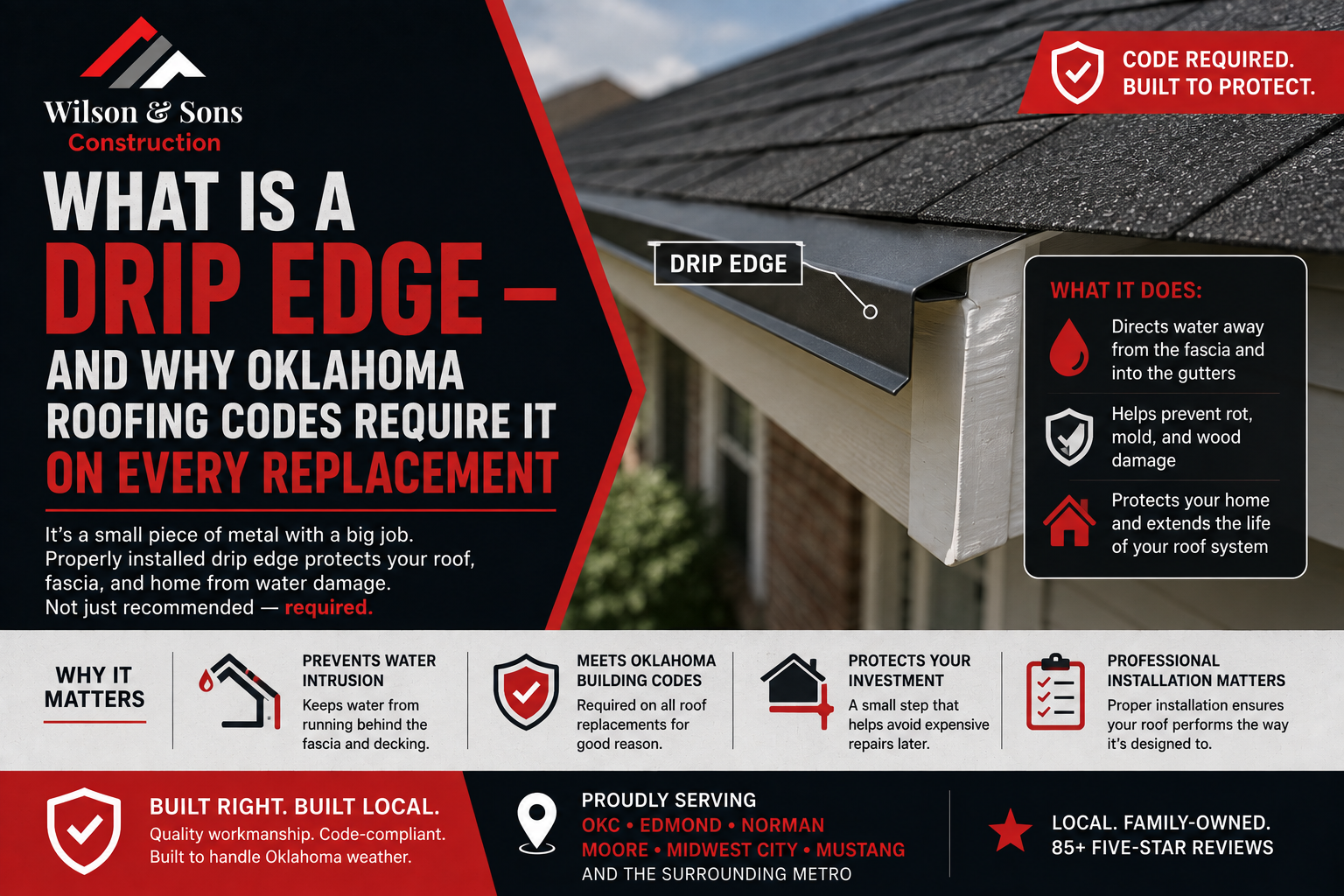
What Is a Drip Edge — And Why Oklahoma Roofing Codes Require It on Every Replacement
Drip edge is an L-shaped or T-shaped metal flashing installed along the eaves and rakes of a roof that directs water away from the fascia board and into the gutters — and under the 2018 International Residential Code (IRC) adopted by most Oklahoma municipalities, drip edge is required on all residential roofs.
Despite being required by code, drip edge is missing from many older Oklahoma homes — and it is one of the most frequently omitted line items in initial insurance estimates after storm damage. Understanding what drip edge does, why it’s required, and how to recover it as a code upgrade item in an insurance claim can add hundreds of dollars to your claim settlement.
What Drip Edge Does
Drip edge performs several distinct functions that protect your home’s envelope at the roof edge — one of the most water-vulnerable points on any structure:
- Directs runoff into the gutter. Without drip edge, water flowing off the shingle surface can run along the underside of the shingle overhang, bypass the gutter entirely, and land directly on the fascia board below. Drip edge creates a physical barrier that ensures water drops into the gutter rather than behind it.
- Protects the fascia from moisture saturation. The fascia is the horizontal board that runs along the lower edge of the roof framing and forms the face of the soffit/eave assembly. When water consistently bypasses the gutter and hits the fascia, the wood absorbs moisture repeatedly — leading to rot, paint failure, and eventually structural deterioration.
- Provides a clean termination edge. Underlayment and shingles need a defined edge to terminate against. Drip edge provides that edge, preventing shingle curl-back at the eave and maintaining the integrity of the underlayment seal.
- Prevents wicking. Without drip edge, capillary action can draw water back under the shingles at the eave during heavy rain events — particularly when wind is present.
- Blocks pest intrusion. The gap between the roof deck edge and the gutter is a common entry point for insects and small animals. Drip edge closes that gap.
Fascia rot is the most common consequence of missing drip edge. When water bypasses the gutter and saturates the fascia for years, the wood deteriorates — often requiring fascia replacement as a secondary cost that drip edge would have prevented. Fascia replacement adds $500-$2,000+ to a roofing project depending on linear footage and material.
Types of Drip Edge
Three drip edge profiles are commonly used in Oklahoma residential roofing:
The most basic L-shaped profile. Adequate for most standard residential eave applications. The most commonly installed type in Oklahoma residential re-roofing.
Extends further back under the underlayment, providing additional coverage of the fascia top. Better protection for situations where the eave overhang is short or the fascia is particularly exposed.
Designed for steeper pitches and situations where the gutter is set lower than the roof deck. The extended lower leg reaches into the gutter to ensure positive drainage.
Materials: Standard residential drip edge is most commonly aluminum — durable, lightweight, corrosion-resistant, and available in a range of powder-coat colors. Galvanized steel is also common and more rigid. Copper drip edge is available for premium applications — particularly in historic and high-value neighborhoods like Nichols Hills — where copper gutters are also used and longevity and appearance are premium considerations.
Color: Drip edge is typically color-matched to the gutter system. Standard colors include white, black, brown, and galvanized silver. Custom powder-coat colors are available on special order.
Why Oklahoma’s Building Codes Require Drip Edge
The requirement is specific and unambiguous. The 2018 International Residential Code, Section R905.2.8.5, states that drip edge shall be provided at eaves and rakes of asphalt shingle roofs. The installation sequence is specified: at eaves, drip edge goes under the underlayment; at rakes (the sloped edge of the roof from eave to ridge), drip edge goes over the underlayment.
2018 IRC Section R905.2.8.5 — Drip Edge: “A drip edge shall be provided at eaves and rakes of shingle roofs. Adjacent pieces of drip edge shall be overlapped a minimum of 2 inches (51 mm). Drip edges shall extend a minimum of ¼ inch (6.4 mm) below the roof sheathing and extend up the roof deck a minimum of 2 inches (51 mm).”
Oklahoma municipalities that have adopted the 2018 IRC — including Oklahoma City, Moore, Edmond, Yukon, Midwest City, Norman, Mustang, Broken Arrow, and Tulsa, among others — are bound by this requirement for new construction and re-roofing projects subject to permit.
Oklahoma City’s re-roofing permit submittal checklist explicitly includes flashing and drip edge as required elements that must appear in the required photo documentation uploaded before final inspection approval. This is a practical enforcement mechanism: a final inspection cannot be passed if drip edge is absent from the photos.
If your existing roof does not have drip edge — common on Oklahoma homes built before approximately 1980, when the requirement was not universally enforced — your insurance company is required to cover the cost of adding it as a code upgrade when you replace your roof following a storm damage claim. Drip edge in this context is not a homeowner-elective upgrade. It is a code-mandated requirement that must be included in any compliant roof replacement.
Drip Edge and Oklahoma Insurance Claims — The Code Upgrade Rule
When a storm damage insurance claim requires full roof replacement, the replacement must bring the roof up to current building code standards — even if the original roof didn’t meet current code. This principle, sometimes called the “ordinance and law” or “code upgrade” provision, is standard in Oklahoma homeowners policies.
Missing drip edge is one of the most commonly recoverable code upgrade items in Oklahoma roofing insurance claims. Here’s why it’s frequently missed from initial scopes:
- Adjusters assessing the roof from the surface may not notice the absence of drip edge, particularly if the eave edge is partially obscured by gutter or soffit.
- Initial scopes are generated based on what is visible and what is typically present — if an adjuster assumes drip edge is present and doesn’t specifically verify its absence, it won’t appear in the estimate.
- The cost, while meaningful ($500-$1,500 for a typical home), is small enough that it may not receive focused attention during a rapid post-storm assessment.
If your existing roof has no drip edge and your insurer’s initial scope of loss omits drip edge, you are entitled to add it as a supplement. Cite the 2018 IRC R905.2.8.5 requirement, and note that your city’s building permit mandates code-compliant installation. Oklahoma City’s re-roofing permit requires photos showing drip edge before final inspection — this confirms it is a required element, not optional.
For a complete guide to recovering missed items in your insurance claim — including drip edge, O&P, gutters, and permit fees — see our full guide on how to file a roofing insurance supplement in Oklahoma.
How Much Does Drip Edge Cost?
| Item | Cost Range | Notes |
|---|---|---|
| Material only (aluminum) | $1.00 – $2.50 / LF | Standard residential aluminum, Type C or D |
| Installed (material + labor) | $2.00 – $5.00 / LF | Includes proper sequencing with underlayment |
| Typical Oklahoma home (250 LF) | $500 – $1,250 | Eaves + rakes; varies with roof perimeter |
| In insurance supplement | $500 – $1,500 | Xactimate pricing; varies by home size and type |
| Copper drip edge (premium) | $8.00 – $15.00 / LF | For copper gutter systems; Nichols Hills, luxury homes |
In an insurance claim supplement, drip edge is priced per linear foot as a separate line item using Xactimate’s published regional pricing. The total recoverable amount depends on the perimeter of your roof and which profile is specified. For most Oklahoma homes, this falls in the $500-$1,500 range — worth pursuing as part of a thorough supplement submission.
How to Check If Your Roof Has Drip Edge
You can check for drip edge from the ground or from the attic without accessing the roof surface:
- From the ground: Look at the edge of the roof where shingles meet the gutter. If you see a metal strip — typically 2-4 inches wide — running along the bottom edge of the shingles before the gutter begins, drip edge is present. If shingles appear to terminate directly at the gutter with no visible metal strip, drip edge is likely absent.
- From the attic: Look at the eave edge from inside the attic space. If you see a metal flange extending beyond the roof deck edge toward the exterior, drip edge is present. If the roof deck terminates abruptly without any metal flange, drip edge is absent.
- By build date: Oklahoma homes built before 1980 very commonly lack drip edge. Modern IRC requirements weren’t universally adopted and enforced until the early 2000s in many Oklahoma jurisdictions. If your home was built before 1980 and has never had a full roof replacement, there is a meaningful probability that drip edge is absent.
- During inspection: If you can’t determine drip edge presence from the ground or attic, have a roofing professional assess it. Wilson & Sons notes drip edge presence and condition as a standard component of our free roof inspection.
If your roof lacks drip edge and you are scheduling a replacement — whether following storm damage or for other reasons — ensure your contractor includes drip edge in the scope. If you have an open insurance claim, this is a supplement item. If you’re replacing for non-insurance reasons, include it in your base contract. A roof installed without drip edge in Oklahoma will not pass final permit inspection in code-adopted municipalities.
For questions about your specific roof’s drip edge status, compliance with Oklahoma building codes, or how to add drip edge to an existing insurance claim scope, contact Wilson & Sons at 405-230-3000 or schedule a free inspection.
Frequently Asked Questions
Drip edge is an L-shaped or T-shaped metal flashing installed along the eaves and rakes of a roof that directs water away from the fascia board and into the gutters, preventing moisture damage to the fascia and water infiltration under the roofing assembly.
Yes. The 2018 International Residential Code (IRC), Section R905.2.8.5, requires drip edge on all asphalt shingle roofs. Most Oklahoma municipalities including Oklahoma City, Moore, Edmond, Yukon, and Midwest City have adopted the 2018 IRC.
If your existing roof lacks drip edge, adding it when replacing your roof is a code upgrade — and insurance is required to cover code upgrades as part of a storm damage replacement claim. If drip edge is missing from your insurer’s initial scope, add it as a supplement citing the 2018 IRC R905.2.8.5 requirement.
Without drip edge, water runs along the shingle edge, down behind the gutter, and onto the fascia board. Over time, this causes fascia rot, paint failure, and potential moisture intrusion into the roof structure. Oklahoma City’s re-roofing permit specifically requires drip edge to be visible in the required photo documentation before final inspection approval.
Material alone runs approximately $1.00-$2.50 per linear foot for standard aluminum drip edge. Installed (material + labor) runs approximately $2.00-$5.00 per linear foot. For a typical Oklahoma home with 250 linear feet of roof perimeter, drip edge installation costs approximately $500-$1,250.
Free Roof Inspection Including Drip Edge Assessment
We check drip edge presence, document it in writing, and identify whether it belongs in your insurance supplement — at no charge.
Schedule Free Inspection →