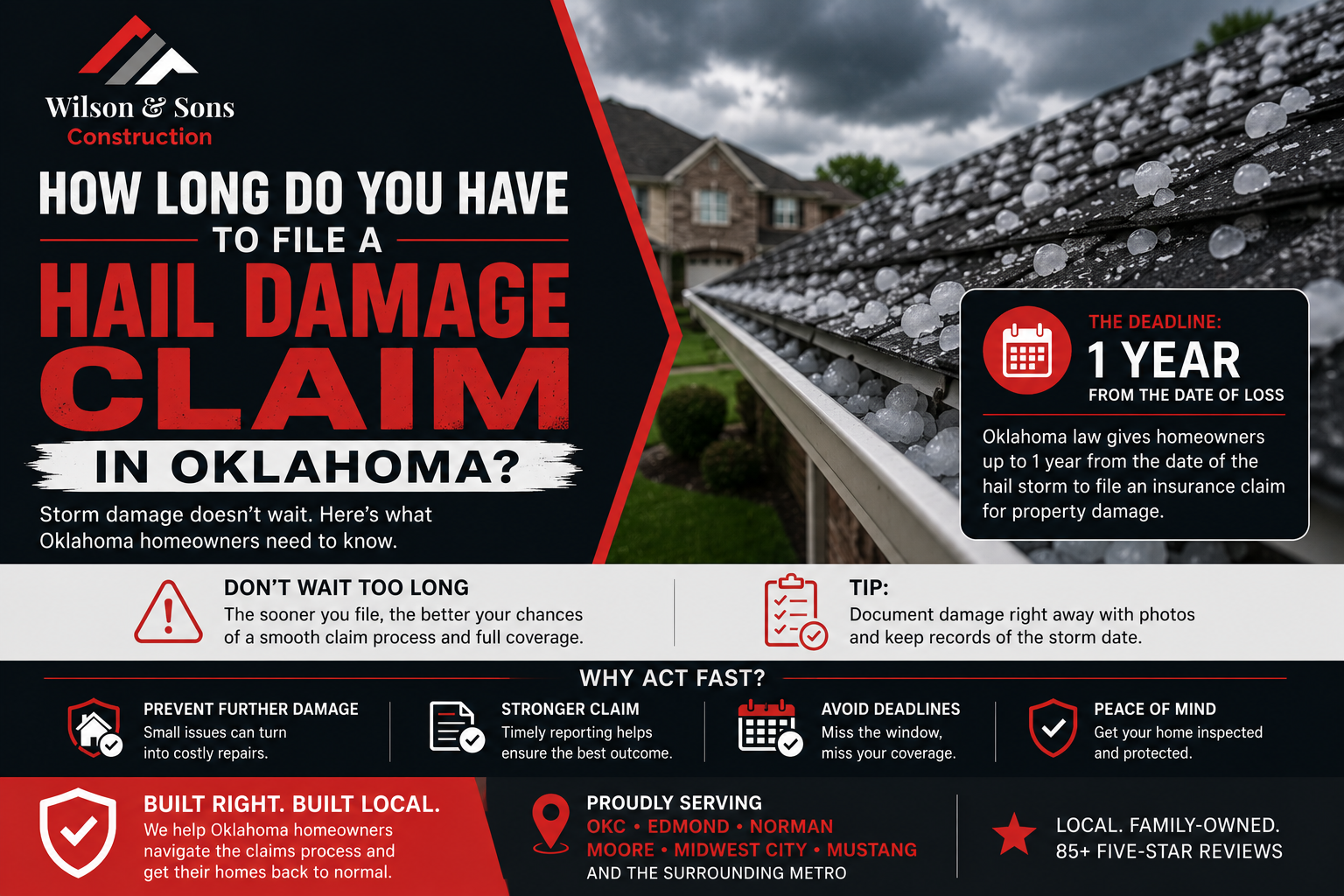
How Long Do You Have to File a Hail Damage Claim in Oklahoma?
By Wilson & Sons Construction · 7 min read · Updated August 2026
Under Oklahoma House Bill 3495, Oklahoma homeowners have 24 months from the date of a covered storm event to file a hail damage or wind damage claim with their homeowner’s insurance company. This 24-month window applies specifically to claims related to weather-related damage including hail and wind, and represents one of the most homeowner-friendly claim windows in the country. However, the clock starts on the date of the storm — not the date you discover the damage.
That distinction — storm date versus discovery date — is where many Oklahoma homeowners lose an otherwise valid claim. Roof damage from hail is frequently invisible from ground level. Shingle bruising, granule displacement, and micro-fractures in the mat can exist for 12 to 18 months before any interior water intrusion makes them obvious. By the time a homeowner notices a problem, the 24-month window may be closing fast. Understanding exactly how HB 3495 works, and acting early, is the difference between a covered repair and an out-of-pocket replacement.
Wilson & Sons Construction has worked through hundreds of Oklahoma hail claims across the Oklahoma City metro and surrounding areas. This guide reflects what we see in the field — the rules, the timelines, and the mistakes that cost homeowners the most money.
What Oklahoma House Bill 3495 Says
Oklahoma House Bill 3495 — sometimes referenced alongside its earlier legislative form, SB 1383 — established a clear statutory minimum for weather-related property damage claim filing windows in Oklahoma. Before this legislation, some insurers wrote policies with filing windows as short as 12 months, leaving homeowners who discovered damage late with little legal recourse.
HB 3495 applies to residential properties and covers claims arising from weather events, including hail storms, wind storms, and related weather-caused damage. The 24-month period runs from the date of the storm event itself, not the date you file or even the date you discover the damage.
The most important protection this bill provides: your insurance policy cannot contractually undercut the statutory minimum. If a policy contains language specifying a 12-month window for storm claims, that provision is unenforceable for weather-related damage in Oklahoma — the 24-month statutory minimum governs. That said, your policy language still matters for other types of claims not covered by HB 3495, so you should always read both your policy and understand the statute before making assumptions.
Oklahoma HB 3495 gives homeowners 24 months from the date of a covered storm event to file a claim. Your insurer cannot contractually shorten this window for weather damage below the statutory minimum. If you are unsure whether this applies to your specific claim, consult a licensed Oklahoma public adjuster or insurance attorney.
Why the Clock Starts at the Storm, Not at Discovery
The practical challenge with Oklahoma’s 24-month window is that roof damage — even significant damage — often produces no visible interior symptoms for many months after a hail event. A storm that deposits 1-inch hail across a neighborhood may crack sealant strips, displace protective granules from shingle surfaces, and create micro-fractures in the fiberglass mat without causing a single water stain on any ceiling in the home.
Granule loss is particularly deceptive. After a hail storm, granules wash off damaged shingles and accumulate in gutters and downspout splash zones. To the untrained eye, this looks like normal wear. A professional inspector recognizes the pattern — dense accumulation in gutters immediately following a storm, combined with bare patches visible on shingles from rooftop inspection — as clear evidence of hail impact. But if no one looks, the clock keeps running.
This is why post-storm inspections within 30 to 60 days are critical, even when your interior looks perfectly fine. By the time water penetrates the damaged mat and shows up on an attic decking or ceiling drywall, you may be well past the 12-month mark from the storm date that caused the original damage. The HB 3495 window doesn’t care about when you noticed the problem — it cares about when the storm happened.
To confirm the official storm date for a specific event, two sources are authoritative and accepted by insurance companies:
- NOAA Storm Events Database — searchable by state, county, and date range, documenting hail size, location, and time of events. Available at the NOAA Storm Prediction Center.
- NWS Norman Forecast Office — the National Weather Service office serving central Oklahoma. Local storm data, storm reports, and archived event records are available at weather.gov/oun.
Both sources are free, publicly accessible, and produce records that insurance adjusters and, if necessary, courts accept as authoritative documentation of storm date and severity.
What Happens If You Miss the 24-Month Window
Once the 24-month window passes for a specific storm event, your insurer has grounds to deny your claim for damage attributable to that event — regardless of how thoroughly you document the damage today. Insurance companies maintain storm tracking databases. When an adjuster evaluates a claim, they cross-reference the reported storm date against NOAA and NWS records. A claim filed at 27 months for a storm they can document occurred 27 months ago will be denied on timeliness grounds.
There is a narrow exception: if you can document that the damage was not reasonably discoverable within the filing period — for example, hidden structural deterioration that could only be detected through invasive inspection — some carriers and some courts have allowed claims to proceed outside the statutory window. These situations are rare, fact-specific, and require legal representation to pursue. Do not count on this exception as a planning strategy.
If you are approaching the end of a 24-month window on a known storm event, the right action is straightforward: open the claim now. You do not need to have selected a contractor. You do not need a complete damage assessment. You simply need to contact your insurer, reference the storm date and address, report suspected weather-related damage, and open the claim. That act preserves your rights. The investigation and settlement process can take weeks or months afterward — what matters is that the claim is on file within the window.
Step-by-Step: What to Do After a Hail Storm
-
1Within 24–48 hours: Document visible exterior damage Walk the exterior of your home and photograph anything you can see from the ground — dented gutters, damaged window screens, AC condenser fins that appear compressed or bent, dents in metal flashing visible at eaves. Note the storm date immediately and write it down. Do not wait to see if anything leaks.
-
2Within 2 weeks: Schedule a professional roof inspection A trained roofing contractor can identify granule loss, shingle bruising, soft metal damage, and flashing failures that are impossible to see from the ground. Wilson & Sons offers free hail damage inspections — no obligation, no pressure, just a documented report of what the storm left behind. This report becomes part of your claim file.
-
3Within 30 days: Open the insurance claim Contact your insurance company and open a claim referencing the storm date and “suspected weather-related damage.” You do not need to know the full scope of damage to open a claim — that’s what the adjuster visit determines. Opening the claim early locks your position within the HB 3495 window. Do not wait for contractor selection before taking this step.
-
4Before the adjuster visit: Prepare your documentation Gather the contractor’s inspection report, NOAA or NWS storm records confirming the event date, and photographs taken immediately after the storm. You have the legal right to have your contractor present during the insurance adjuster’s site assessment. Having a knowledgeable contractor present significantly reduces the chance that storm-related items are overlooked in the initial scope.
-
5After the initial settlement: Review the scope carefully Insurance adjusters work quickly and may miss legitimate storm-related items — drip edge, pipe boots, ridge cap shingles, gutter spikes, satellite mounts, and other components that are damaged by hail but not always line-itemed in a standard scope. Your contractor can review the Xactimate scope of loss and submit a “supplement” for any items that were missed or undervalued. This is a legal, standard practice in Oklahoma and does not constitute fraud when the supplemented items are legitimately storm-damaged.
What If You Have Already Missed the Window?
If the 24-month window has definitively passed for a specific storm event, you cannot file a valid claim for damage attributable to that storm. This is not a situation where persistence or documentation can overcome the statutory timeline — the window is fixed.
However, two facts are worth considering before drawing that conclusion:
First, confirm the exact storm date using NOAA records rather than relying on your memory of when the storm happened. Some homeowners overestimate how long ago a specific event occurred. If a neighbor mentioned hail damage at a cookout two summers ago, that anecdote is not documentation — the NOAA record is. You may find that the storm you are thinking of occurred more recently than you believe.
Second, if your roof has been exposed to multiple storm events over several years, each event has its own separate 24-month window. If a 2024 storm damaged your roof on top of pre-existing 2022 storm damage, you can file for the 2024 event’s damage even if the 2022 window has closed. The two claims are separate. An experienced contractor can help document which damage patterns are consistent with which storm events.
Confirm the exact storm date using NOAA’s Storm Events Database. Some homeowners overestimate how long it has been since a specific event. The official record — not memory — determines your window.
If no legitimate insurance path exists for your specific situation, Wilson & Sons provides straight-line replacement pricing for residential roofing projects paid directly by homeowners. We can evaluate your roof’s condition and give you an honest assessment of what replacement would cost and what options are available to you.
Common Mistakes That Cost Oklahoma Homeowners Their Claim
After years of working through Oklahoma hail claims, these are the errors we see most consistently — each of them preventable with the right information in advance.
- Waiting to open the claim until you’ve selected a contractor. You can — and should — open your claim as soon as possible after a storm, even before selecting a contractor. Opening the claim does not obligate you to complete repairs. It simply preserves your rights under HB 3495.
- Signing an Assignment of Benefits (AOB) without understanding it. An AOB transfers your insurance claim rights to a third party. In some situations this is appropriate; in others it can lead to disputes over your settlement proceeds. Read any document before signing, and understand what rights you are transferring.
- Working with contractors who offer to “cover your deductible.” In Oklahoma, waiving a homeowner’s insurance deductible is insurance fraud — both for the contractor and, potentially, for the homeowner. Licensed contractors do not offer this. If a contractor makes this offer, walk away.
- Not having your contractor present at the adjuster’s visit. The initial adjuster scope is not the final word. But it is much easier to get items included in the original scope than to supplement them afterward. Having your contractor on-site during the adjuster’s visit increases the completeness of the initial scope of loss.
- Failing to document the storm date with official sources. Memory and neighbor conversations are not documentation. Pull the NOAA and NWS records for the storm and keep them in your claim file. This single step prevents a large category of disputes about whether a reported storm actually occurred.
- Accepting the first settlement offer without review. The first settlement offer from an insurer is based on the adjuster’s initial scope and is not always complete or final. Review it with your contractor before signing any releases. If items are missing, a supplement can add them — but once you sign a release, your options narrow significantly.
Working with an Insurance Claim Adjuster
The insurance adjuster assigned to your claim works for the insurance company. That is not a criticism — it is a structural fact that shapes how the claims process works. Adjusters are trained to assess damage accurately, but they work on volume, and some items that an experienced roofing contractor would flag get missed in a standard adjuster review.
Your rights during the claims process include: the right to request reinspection if you believe the initial assessment was incomplete, the right to have your contractor present at any site visit, the right to dispute line items through your insurer’s formal dispute process, and — in serious disputes — the right to invoke the appraisal clause that most Oklahoma homeowner policies contain, which allows each party to hire an independent appraiser to establish the loss amount.
Wilson & Sons works regularly alongside insurance adjusters and understands the Xactimate pricing software most carriers use. We can review your scope of loss, identify any items that were overlooked, and submit a professional supplement on your behalf. For more detail on how the adjuster process works, see our guide on working with a roof insurance claims adjuster in Oklahoma.
Frequently Asked Questions
Does Oklahoma’s 24-month rule apply to all home insurance claims?
No. Oklahoma House Bill 3495 specifically covers weather-related damage including hail and wind. Other types of claims — fire, theft, water damage from internal plumbing failures — may have different filing windows specified in your policy. HB 3495’s 24-month minimum applies to covered storm damage claims. Always check your full policy language for other claim types.
When does the 24-month window start — storm date or discovery date?
The 24-month window starts on the storm date under Oklahoma HB 3495, not the date you discover the damage. This is a critical distinction: even if you find damage 22 months after a storm, the clock has been running since the storm occurred. If you’ve located damage at month 22, open the claim immediately.
Can my insurance company give me less than 24 months to file a weather claim?
No. Oklahoma HB 3495 establishes a statutory minimum that cannot be shortened by contract for covered storm damage. If your policy language specifies a shorter window for hail or wind claims, the statute controls. Your insurer cannot enforce a contractual provision that falls below the statutory floor for weather-related damage.
What if I open a claim and then decide not to pursue it?
You can withdraw a claim after opening it, though it may still appear in your claims history even if no payment is made. Some insurers use claims history when calculating future premiums. Consult your insurance agent before withdrawing a claim to understand the specific implications for your policy before making that decision.
How do I find the exact date of a hail storm in my area?
NOAA’s Storm Events Database (accessible through the NOAA Storm Prediction Center) and the NWS Norman forecast office maintain official records of hail events with date, time, hail size, and affected locations. These records are accepted documentation for insurance claims and are searchable by county and date range at no cost.
Can my contractor help me file a supplement after the initial settlement?
Yes. Contractors routinely review an insurance scope of loss document and submit supplements for items the adjuster missed or undervalued — such as drip edge, pipe boots, ridge cap, gutter hardware, or satellite dish mounting repairs. Supplementing is legal, standard practice in Oklahoma, and does not constitute fraud when the items are legitimately storm-related and accurately priced.
What’s the difference between the 24-month filing window and my roof’s depreciation schedule?
These are separate issues. The 24-month window governs when you must file the claim. Depreciation affects how much you receive initially. With replacement cost value (RCV) coverage, you typically receive an initial payment minus depreciation, then recover the depreciation holdback after repairs are completed and invoiced — regardless of the roof’s age. Filing on time is the prerequisite; how much you collect depends on your coverage type and the scope of documented damage.
Schedule Your Free Hail Damage Inspection
Don’t let the 24-month window close on a valid claim. Our inspectors document granule loss, shingle bruising, and soft metal damage with the detail your insurer needs to process a complete claim.