Roofing · Home Performance
Attic Ventilation and Your Oklahoma Roof: The Connection Most Homeowners Miss
Wilson & Sons Construction • Oklahoma City, OK • Updated June 2026
When a homeowner calls about a roof that is curling at the edges, showing granule loss within 10 years of installation, or developing soft spots in the decking, the conversation almost always turns to the same subject: attic ventilation. It is one of the most consequential — and most consistently overlooked — elements of a home’s roofing system. And in Oklahoma’s climate, where attic temperatures can reach dangerous extremes in both summer and winter, the consequences of getting it wrong are faster and more expensive than in almost any other region of the country.
This guide explains how attic ventilation works, why Oklahoma’s climate makes it particularly critical, what goes wrong when it is inadequate, and what Wilson & Sons checks during every roof inspection.
How Proper Attic Ventilation Works
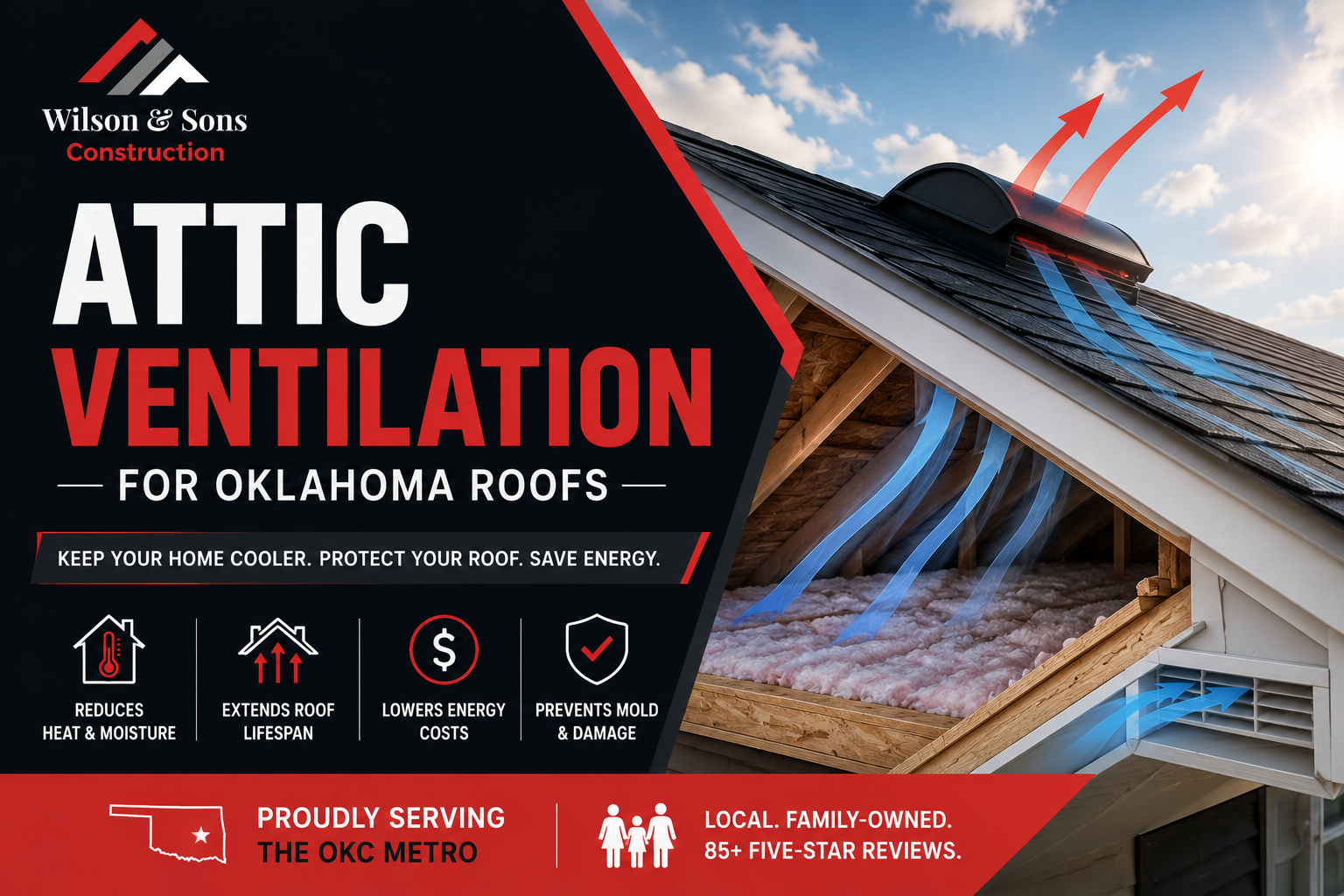
A correctly ventilated attic is a passive system driven by natural air movement — no fans, no mechanical components, no electricity required. The fundamental principle is straightforward: cool outside air enters at the low point of the roof (typically at soffit or eave vents), and warm air exits at or near the ridge (through a ridge vent or high gable vents). As hot air rises and exits, it draws cooler air in behind it, creating continuous circulation.
The International Residential Code — adopted in Oklahoma — specifies a minimum ventilation ratio of 1 square foot of free ventilation area for every 150 square feet of attic floor space. This ratio applies when ventilation is split approximately 50/50 between low intake (soffit) and high exhaust (ridge or gable near peak).
The 50/50 balance is as important as the total area. A roof with abundant ridge venting but blocked soffits cannot move air effectively. Similarly, abundant soffit intake with inadequate ridge exhaust creates pressure imbalances. The system works as a balanced circuit, not as two independent components.
Note: The 1:150 ratio is a minimum. Oklahoma’s climate often warrants exceeding it, particularly on homes with low attic profiles or high heat loads.
Summer: How Heat Destroys Your Roof From the Inside Out
This is the mechanism Oklahoma homeowners most urgently need to understand. Asphalt shingles are designed to withstand significant heat — but heat from above, not from below. When attic ventilation is inadequate in an Oklahoma summer, the attic becomes a heat trap.
On a 100°F Oklahoma summer day — which occurs regularly in July and August in the OKC metro — an unventilated or poorly ventilated attic can reach 150 to 160°F. That heat radiates upward into the roof decking and through the decking into the shingles. The shingles effectively cook from underneath at the same time they are receiving intense solar radiation from above.
The effects on asphalt shingles are specific and cumulative:
- Accelerated granule loss. The granules embedded in asphalt shingles protect the underlying asphalt mat from UV exposure. Extreme heat from below loosens the bond between granules and mat. Granule loss accelerates UV degradation dramatically — a shingle losing granules is aging years faster than its manufacturer expected.
- Asphalt volatilization. The asphalt in shingles contains oils that keep it flexible. Extreme heat drives off these oils, causing the shingle to become brittle. Brittle shingles crack along nail lines in Oklahoma’s wind events rather than flexing. They also curl upward at edges and tabs.
- Premature warranty failure. Shingle manufacturers design products for specific installation conditions, including assumed ventilation standards. A roof installed on an inadequately ventilated attic will fail years before the warranty period — and shingle manufacturers inspect attic ventilation when evaluating warranty claims. An inadequately ventilated attic can void your warranty.
Proper attic ventilation can reduce attic temperatures by 30 to 40 degrees Fahrenheit on a peak summer day. That temperature reduction directly translates to extended shingle life — often 5 to 10 additional years on a 30-year shingle product.
The energy bill connection: A 150°F attic does not stay contained in the attic. That heat radiates into conditioned living space below, forcing your HVAC system to work substantially harder to maintain indoor temperature. Improving attic ventilation typically reduces summer cooling costs measurably — a benefit that compounds over the life of the home.
Winter: How Moisture Damages Your Roof Deck
The same ventilation system that exhausts heat in summer serves a critical moisture management function in winter. Oklahoma winters bring periods of high interior humidity relative to cold exterior temperatures — the combination that creates the conditions for condensation damage.
Warm, humid air from the living space — generated by cooking, showering, breathing, and everyday activities — naturally rises and migrates upward. It passes through ceiling insulation and enters the attic space. When that humid air reaches the cold roof decking (plywood or OSB sheathing attached to the underside of the roof), the temperature drop causes the moisture to condense into liquid water on the decking surface.
This condensation, occurring night after night during cold Oklahoma winters, causes:
- Decking delamination. Plywood and OSB sheathing absorb water and delaminate over time — the layers separate, causing soft spots that are structurally compromised and must be replaced during any subsequent roofing work.
- Mold and mildew growth. The combination of moisture and organic material (wood) in a dark, warm-ish space is ideal for mold development. Attic mold is an indoor air quality issue as well as a structural one.
- Rafter and framing rot. Persistent moisture exposure degrades wood framing over time. Rot in rafter tails is particularly common and particularly expensive to repair because it involves structural framing, not just decking.
Proper ventilation continuously exhausts this moisture-laden air before condensation occurs. The same airflow that carries heat out in summer carries moisture out in winter — which is why a properly balanced ventilation system is a year-round asset, not a seasonal one.
Ice Dams: Less Common in Oklahoma, But Worth Understanding
Ice dams are more commonly associated with northern climates, but they do occur in Oklahoma during significant winter freeze events. Understanding why they form clarifies the importance of uniform attic temperature management.
An ice dam forms when heat escaping from a poorly ventilated attic warms the roof deck unevenly. Snow or ice on the upper portion of the roof (above the warm section) melts and runs down toward the eaves. At the eaves — which overhang beyond the insulated space and stay cold — that water refreezes. The resulting dam backs water uphill under the shingles, where it can penetrate into the attic and living space.
Proper ventilation keeps the entire roof deck close to the same temperature as the exterior air, eliminating the differential that causes differential melting. This is another reason that balanced soffit-to-ridge airflow matters: it prevents warm air from concentrating near the peak while eave areas stay cold.
Signs Your Oklahoma Roof Has a Ventilation Problem
- Shingles curling or cupping prematurely — on a roof less than 15 years old, curling shingles often indicate heat damage from below rather than simple age
- Granule loss within 10–15 years on a product rated for 30 years or more
- Upper floors significantly warmer than lower floors in summer, even with consistent HVAC operation
- High cooling bills despite good insulation — attic heat load is a common hidden driver
- Visible mold or frost in the attic during or after cold weather
- Soft spots in the roof deck detected during a professional inspection — indicates moisture damage to decking
- Icicles forming unevenly along the roofline in winter, with thick deposits at eaves but not elsewhere
Oklahoma-Specific Ventilation Problems We Commonly Find
After inspecting roofs across the OKC metro for more than 25 years, Wilson & Sons consistently encounters the same patterns of ventilation failure. Understanding them helps homeowners know what to ask about.
Blown-In Insulation Blocking Soffit Vents
This is the single most common ventilation problem we find in Oklahoma homes, and it is entirely preventable. When homeowners add blown-in attic insulation — a worthwhile energy efficiency investment — the insulation must be kept clear of the soffit vents using foam or cardboard baffles installed before insulation is blown. When baffles are not in place, blown insulation drifts to cover the soffit vent openings, cutting off the intake side of the ventilation circuit entirely. The ridge vent remains open but cannot draw air because there is no intake. The result is effectively zero net ventilation despite adequate vent area on paper.
Powered Attic Fans Without Balanced Intake
Powered attic fans seem intuitive — more airflow must be better. But a powered fan exhausting more air than the intake vents can supply creates negative pressure in the attic. That negative pressure pulls conditioned air from the living space up through ceiling penetrations, light fixtures, and attic hatches — essentially sucking your air-conditioned air out of your home. The net effect can be higher energy bills, not lower. Powered fans require intake capacity that matches or exceeds their exhaust volume, which is rarely present in homes where they are added as afterthoughts.
Ridge Cap Installed Over Ridge Vent
This error occurs at installation. Ridge vents are designed to be covered by a ridge cap shingle, but the installation must leave the vent slots open. When ridge cap shingles are nailed too tightly or the wrong product is used, the slots in the ridge vent are compressed and blocked. The ridge vent is present and visible from the ground, but is doing nothing.
Inadequate Vent Coverage on Additions
When a room addition or covered porch is built, the new roof area often does not receive proportional ventilation — or receives none at all. The original roof ventilation system is not sized for the increased area, and the addition creates a heat trap that affects the broader attic system.
What Wilson & Sons Checks During Every Inspection
Ventilation assessment is a standard component of every free roof inspection we provide. Specifically, we look at:
- Soffit vent condition, coverage, and whether openings are clear or blocked
- Ridge vent installation quality and whether the exhaust slots are functional
- Presence and proper placement of insulation baffles at soffit junctions
- Any visible signs of moisture damage in accessible attic decking
- Gross balance of intake versus exhaust area
- Evidence of powered fans and whether they appear balanced with intake capacity
When we find ventilation deficiencies, we document them and include them in our inspection report. This matters particularly during roof replacement: addressing ventilation during a roof replacement is dramatically less expensive than addressing it as a separate project later. The roof deck is already accessible, the soffit trim is already disturbed, and the cost of adding properly installed baffles or upgrading soffit vent coverage during replacement is a fraction of doing it independently.
If you are planning a roof replacement or want to understand the current state of your roof’s ventilation, start with a free inspection from Wilson & Sons. Our residential roofing services include a full ventilation assessment as part of every project scope. Contact us to schedule.
Frequently Asked Questions: Attic Ventilation and Oklahoma Roofs
How hot does an unventilated attic get in an Oklahoma summer?
On a 100°F Oklahoma summer day, an unventilated or poorly ventilated attic can reach 150 to 160 degrees Fahrenheit. Properly balanced attic ventilation can reduce that temperature by 30 to 40 degrees. That temperature reduction directly extends the life of asphalt shingles, which are designed for heat exposure from above but degrade significantly faster when baked from below as well. Oklahoma’s long, intensely hot summers make this damage mechanism more severe here than in moderate-climate states.
My roof is only 12 years old and the shingles are already curling. Could ventilation be the cause?
Yes, it is one of the most common causes of premature shingle curling and granule loss on roofs that should have decades of life remaining. When shingles curl or cup significantly before the 20-year mark on a product rated for 30+ years, heat from inadequate ventilation is frequently the culprit. A professional inspection that includes attic ventilation assessment can determine whether this is the case and whether the underlying ventilation problem can be corrected to preserve what remains of the roof’s lifespan.
I had blown-in insulation added a few years ago. Could that have affected my ventilation?
Possibly, and this is worth checking. Blown-in insulation added without proper baffles at the soffit junctions can cover and block the soffit intake vents, which are the entry point for the ventilation circuit. When soffit vents are blocked, the entire ventilation system stops functioning regardless of how many ridge vents are present. An inspection can check whether your soffit vents are clear and whether baffles are in place. If they are not, correcting this can restore ventilation function without any major structural work.
Does a powered attic fan improve ventilation?
Not necessarily, and in some configurations it can actually increase energy costs. A powered attic fan that exhausts more air than the passive intake vents can supply creates negative pressure in the attic, which pulls conditioned air from the living space upward through ceiling penetrations. This effectively air-conditions the attic at your expense. Powered fans can be effective when properly sized and balanced with sufficient intake capacity, but they require careful assessment to ensure they are helping rather than hurting.
Is attic ventilation checked as part of Wilson & Sons’ roof inspection?
Yes. Every free roof inspection we provide includes an attic ventilation assessment — soffit vent condition, ridge vent function, baffle presence, any visible moisture damage in accessible decking, and a general evaluation of intake/exhaust balance. When we identify ventilation deficiencies, we include them in the inspection report and discuss corrective options. If a roof replacement is planned, we strongly recommend addressing ventilation at the same time, when the cost and disruption are significantly lower than a separate project.
Is Poor Ventilation Shortening the Life of Your Oklahoma Roof?
Wilson & Sons provides free roof inspections that include a full attic ventilation assessment. If your shingles are aging faster than they should — or you want to verify your system is correct before your next storm season — schedule a free inspection today.