James Hardie vs. Vinyl Siding in Oklahoma: An Honest Climate-Based Comparison
In Oklahoma’s climate, James Hardie fiber cement siding outperforms vinyl siding on hail resistance, UV stability, dimensional stability in extreme heat, and long-term paint retention — though vinyl siding costs significantly less to install, with fiber cement running approximately $10-$20 per square foot installed versus $5-$12 for vinyl.
That opening sentence is the honest bottom line. If you are standing in a showroom or getting competing estimates, the question is not which product is objectively superior in a laboratory — it is which product makes financial and practical sense for a house in Oklahoma. The answer depends heavily on where you live, how long you plan to stay, and what your roof has absorbed during the last three hail seasons. This guide breaks that down without the sales pressure.
Why Oklahoma’s Climate Makes This Comparison Different
Oklahoma’s climate is not a single stressor — it is a combination of extreme conditions that, taken together, push siding products harder than almost any other region in the continental United States. In moderate-climate markets like the Pacific Northwest or the mid-Atlantic, the vinyl-versus-fiber-cement debate is genuinely close. In Oklahoma, the calculus shifts meaningfully toward fiber cement.
The stressors that matter most for siding selection in Oklahoma are: summer temperatures that routinely exceed 100°F with intense solar radiation on south- and west-facing walls; freeze-thaw cycling that can drop temperatures below zero in the same calendar year; annual rainfall averaging 36 inches, arriving heavily in spring storm bursts; humidity drawing up from Gulf of Mexico moisture; and — critically — hail frequency. Oklahoma sits in the heart of what climatologists and insurers call Hail Alley, an arc from Texas north through Kansas that sustains more large-hail events per square mile than any other region of the country.
Oklahoma City receives approximately 36 inches of rainfall per year and sits in the heart of what the NOAA Storm Prediction Center identifies as one of the highest hail-frequency corridors in the United States — making hail resistance a critical siding selection factor.
Each of these stressors bears differently on vinyl versus fiber cement. Understanding which product handles each stress best is how you make the right decision for your specific home and situation.
Hail Resistance — The Oklahoma-Specific Factor
Hail resistance is the single factor that most clearly separates these two products in an Oklahoma context. Impact resistance for siding products is tested under UL 2218, the same protocol used to classify impact-resistant roofing shingles. The rating scale runs from Class 1 (lowest) through Class 4 (highest), and the practical difference is significant.
James Hardie fiber cement siding is rated Class 4 — the highest available classification. In testing, Class 4 materials survive a 2-inch steel ball dropped from 20 feet without cracking or fracturing. This is the same standard that Class 4 impact-resistant roofing shingles must meet, the classification that qualifies Oklahoma homeowners for insurance premium discounts in many policies.
Vinyl siding is typically rated Class 1 or Class 2 for impact resistance. That gap matters in practical terms because golf-ball-size hailstones — 1.75 inches in diameter — are common across Oklahoma’s hail seasons. Hailstones of that size, and larger, will crack, dent, or puncture Class 1 and Class 2 vinyl panels. The same event will leave fiber cement with little to no visible damage.
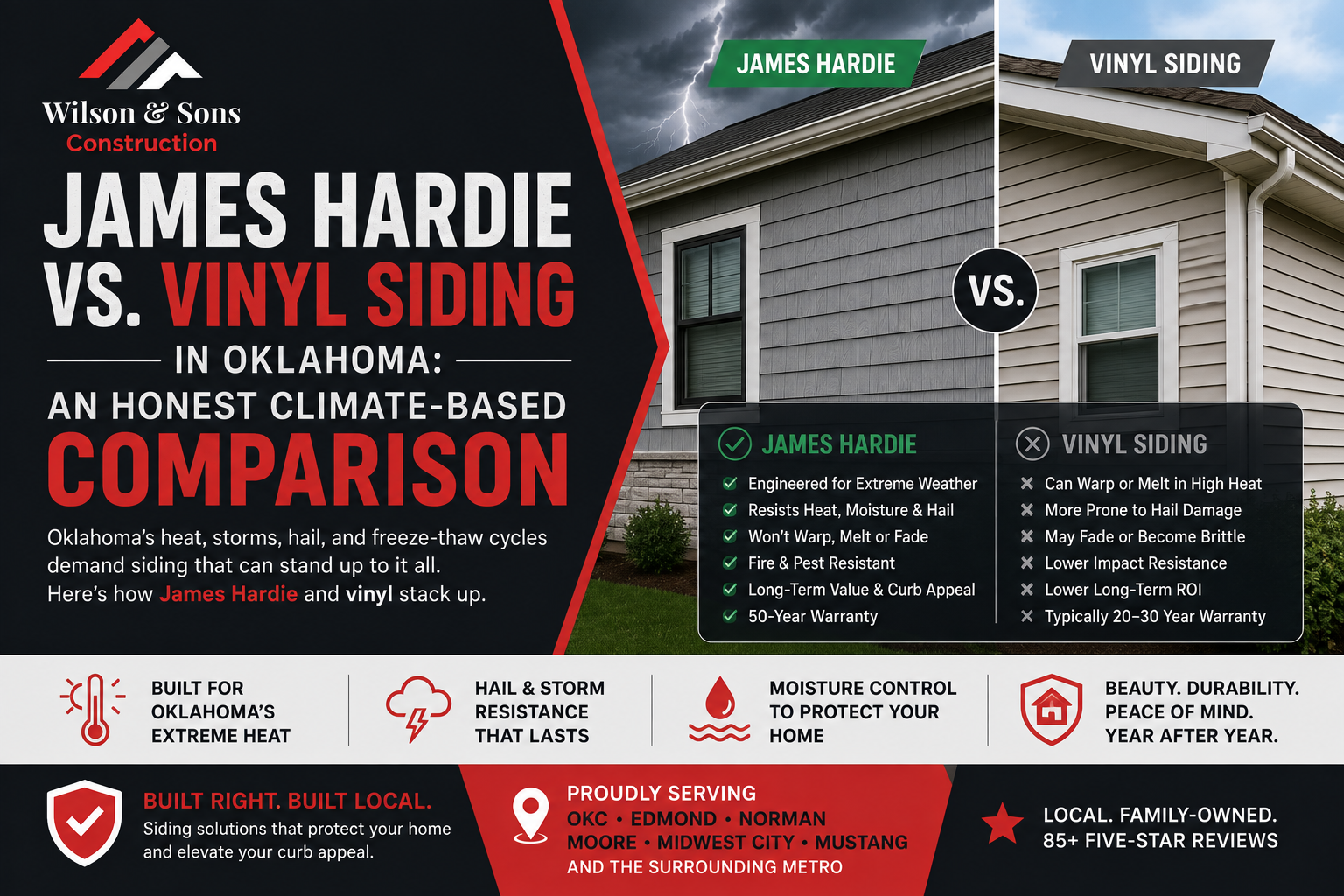
James Hardie siding is rated Class 4 under UL 2218 impact testing. Most vinyl siding is rated Class 1 or 2 — meaning golf-ball-size Oklahoma hailstones that barely mark fiber cement can crack or dent vinyl panels, triggering insurance claims.
The insurance implications are real. Many Oklahoma insurers offer premium discounts for Class 4 impact-rated siding, similar to the discounts that have become standard for Class 4 roofing shingles. If your insurer offers that discount, the premium savings over 15-20 years can meaningfully narrow the upfront cost gap between the two products.
The recent Oklahoma hail record makes this concrete: a September 2024 storm system caused an estimated $300 million in regional property damage. A May 2025 event produced baseball-size hail across Canadian County. These events routinely generate large volumes of vinyl siding replacement claims. Fiber cement structures in the same storm paths sustain minimal siding damage, even when roofing repairs are required.
Heat and UV Performance — Oklahoma Summers at 100°F+
Oklahoma regularly records 100°F or higher temperatures through July and August, and south- and west-facing walls absorb intense solar radiation during those months. The cumulative effect on siding is not trivial, and vinyl and fiber cement respond to that heat very differently.
Vinyl siding expands and contracts with temperature. In moderate climates, this thermal cycling is manageable. In Oklahoma’s extreme range — subzero winter temperatures to 105°F summer peaks — the expansion and contraction is severe enough to cause real problems: panel warping and buckling over time, gaps opening between panels as installation tolerances are repeatedly exceeded, and brittleness in cold temperatures that makes panels more susceptible to impact damage. Color fading is another consequence: vinyl’s integral pigment bleaches under sustained UV exposure, and most vinyl siding shows visible fading within 8 to 12 years in Oklahoma’s environment.
James Hardie fiber cement is dimensionally stable — it does not expand and contract significantly with temperature changes. James Hardie produces products in regional formulations called HardieZone designations; HZ10 is the classification for hot, humid climates, which covers Oklahoma. The factory-applied ColorPlus® finish — available on HardieZone products — carries a 15-year limited warranty against fading, peeling, and cracking. That is a substantially longer color life than vinyl’s typical fade timeline.
James Hardie’s HardieZone® HZ10 product line is specifically engineered for hot, humid climates like Oklahoma’s. The factory-applied ColorPlus® finish carries a 15-year fade warranty — compared to vinyl’s typical 8-12 year color life before visible fading begins.
Lifespan and Maintenance Comparison
James Hardie fiber cement siding carries a manufacturer-rated 50-year lifespan. It resists rot, insect damage, and moisture absorption — common failure modes for wood-based products — and its composition is inert to the biological processes that degrade organic materials. Repainting is required every 15 to 20 years when the factory ColorPlus® finish is not applied; with the factory finish, the first repaint interval extends to 15 years or beyond.
Vinyl siding carries a manufacturer-rated 20 to 40 year lifespan. It requires no painting because the color is integral to the material — this is often cited as a primary advantage. The complication is that when the color fades to a degree that affects curb appeal, vinyl cannot be successfully repainted to match or refresh the original appearance. The choices at that point are to live with faded panels or replace the siding. On a 50-year horizon, that dynamic changes the total cost comparison.
Fiber cement siding can be painted any color at any time. Vinyl cannot be repainted successfully — when the original color fades, replacement is the only option. Over a 50-year horizon, fiber cement’s repaintability makes total cost of ownership comparable to vinyl despite higher upfront cost.
Both products require periodic cleaning. Fiber cement benefits from inspection of caulked joints at trim and window openings. Vinyl benefits from clearing of any organic debris that can accumulate behind panels in Oklahoma’s humid spring months.
Full Cost Comparison — Upfront and Over 50 Years
The upfront cost difference between vinyl and fiber cement is real and material. Fiber cement costs more to manufacture, more to transport (it is heavier than vinyl), and more to install — it requires more skilled labor, specific fastening requirements, and careful handling to avoid fracture during installation. That cost difference should be part of an honest comparison.
| Factor | Vinyl Siding | James Hardie Fiber Cement |
|---|---|---|
| Installed cost (per sq ft) | $5–$12 | $10–$20 |
| Lifespan | 20–40 years | 50 years |
| Painting required | Never (integral color) | Every 15–20 years (~$3–$7/sq ft) |
| Hail damage frequency (OK) | Moderate–High | Low–Very Low |
| Insurance discount eligible | Rarely | Sometimes (Class 4 rated) |
| Heat stability (OK summers) | Moderate (warps/fades) | Excellent (dimensionally stable) |
| Mid-life replacement likelihood | Higher | Lower |
On a 2,000 sq ft home exterior: vinyl installation runs $10,000–$24,000; James Hardie installation runs $20,000–$40,000. The gap narrows significantly over 50 years when accounting for vinyl’s potential mid-life replacement, repainting of fiber cement, and insurance considerations.
When Vinyl Is the Right Choice in Oklahoma
There are legitimate situations in Oklahoma where vinyl siding is the correct choice, and acknowledging them is part of giving homeowners an honest comparison.
Budget constraints are the most common. If the total available project budget does not support fiber cement — which is a real constraint for many homeowners — quality vinyl siding from reputable manufacturers is a legitimate choice. A properly installed vinyl product is meaningfully better than deferred maintenance on deteriorating older siding.
Short-term ownership horizon matters as well. If a homeowner plans to sell within 5 to 7 years, the upfront cost premium of fiber cement is unlikely to be fully recovered in the sale price, particularly in mid-range neighborhoods. Vinyl may deliver a better return on investment in that timeframe.
Some Oklahoma HOA covenants specify siding type, brand, or color by name. Verify the covenant requirements before ordering any product. Fiber cement and vinyl are sometimes treated differently in HOA specifications, and ordering the wrong product can create expensive problems.
Finally: if existing vinyl siding is structurally sound but has localized damage from a specific storm event, partial replacement with matching vinyl panels is often more practical and cost-effective than full replacement with fiber cement. The goal is the right outcome, not the most expensive one.
When James Hardie Is the Right Choice in Oklahoma
Repeated hail claims are the clearest signal that fiber cement should be considered. If a home has received two or more siding replacement claims from hail events in the last decade, upgrading to Class 4 fiber cement at the time of the next replacement is worth a serious cost-benefit analysis — including the conversation with the insurer about what a Class 4 rating does to the premium.
Long-term ownership amplifies the value of fiber cement’s durability. Homeowners planning to stay 15 years or more capture more of the lifespan advantage and are more likely to see the point at which vinyl would require replacement while fiber cement does not. The 50-year rated lifespan is most meaningful when the homeowner has the time horizon to use it.
Premium Oklahoma neighborhoods — Nichols Hills, Heritage Hills, the Coffee Creek corridor in Edmond — have expectations around exterior materials that align better with fiber cement’s profile and finish quality. Fiber cement also holds paint color better over time, which matters in neighborhoods with active architectural review processes.
Insurance-driven calculations deserve careful attention. If your specific insurer offers a meaningful premium discount for Class 4 siding, and the discount is large enough to materially offset the upfront cost difference over a reasonable payback period, the financial case for fiber cement strengthens considerably. This varies by insurer and policy, so the conversation with your insurance agent should happen before you make a final material selection.
Frequently Asked Questions
For most Oklahoma homeowners planning to stay 10+ years, yes — primarily because of hail resistance (Class 4 rating), heat stability, and the 50-year lifespan versus vinyl’s 20-40 year life. The cost premium is more justified in Oklahoma than in moderate-climate states due to the state’s extreme heat and hail exposure.
Vinyl siding is rated Class 1 or 2 for impact resistance and will crack or dent under golf-ball-size (1.75″) and larger hailstones — which are common in Oklahoma’s hail seasons. James Hardie fiber cement is rated Class 4 and handles these impacts significantly better.
$10–$20 per square foot installed, depending on profile (lap, shingle, board-and-batten), home complexity, and prep work required. A 2,000 sq ft home exterior typically runs $20,000–$40,000 for fiber cement vs. $10,000–$24,000 for vinyl.
Yes — vinyl siding typically shows visible color fading within 8-12 years in Oklahoma’s intense UV environment, and vinyl cannot be repainted to match the original color. James Hardie’s factory-applied ColorPlus® finish carries a 15-year fade warranty for hot/humid climates.
Yes — fiber cement siding is non-combustible. James Hardie siding has achieved a Class A fire rating, the highest available. Vinyl siding, while it does not spread flames quickly, is combustible and melts in fire conditions.
Some Oklahoma insurers offer premium discounts for Class 4 impact-rated siding similar to the discounts offered for Class 4 roofing shingles. Verify with your specific insurer before making the upgrade decision based on insurance savings.
Get a Free Siding Estimate — Vinyl and Fiber Cement Options Available
Wilson & Sons installs both vinyl and James Hardie fiber cement siding across the Oklahoma City metro. We will walk you through the honest cost and performance comparison for your specific home.
Request Your Free Estimate