Storm Preparedness · Oklahoma Homeowner Guide
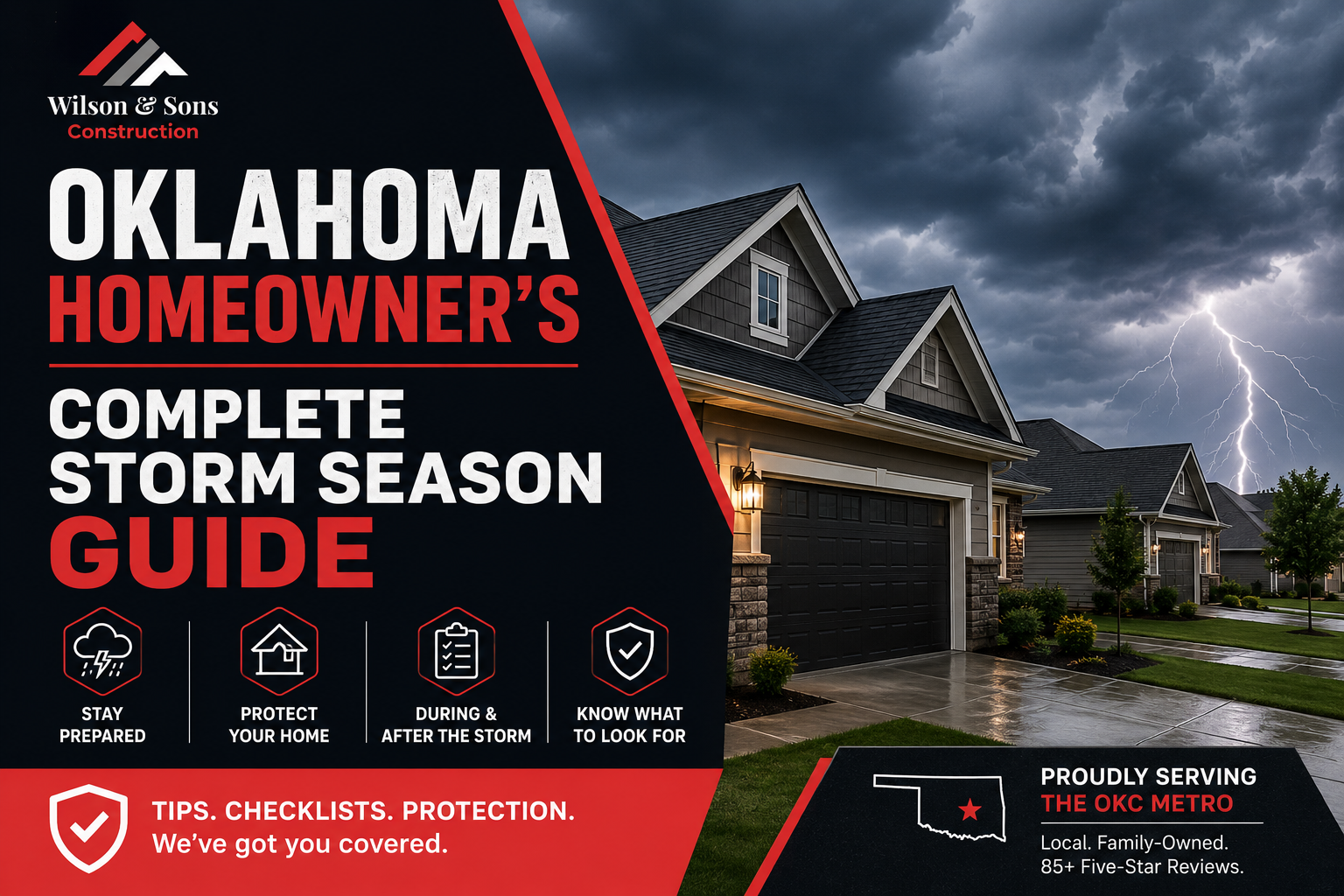
The Oklahoma Homeowner’s Complete Storm Season Guide: Before, During, and After
Wilson & Sons Construction • Oklahoma City, OK • Updated June 2026
Oklahoma does not have a question mark on storm season. It has a calendar. Every spring, the collision of Gulf moisture and Arctic cold fronts over the Southern Plains produces the conditions that made Oklahoma a place where storm preparedness is not optional — it is a basic responsibility of home ownership. The NOAA Storm Prediction Center consistently identifies the Oklahoma City metro and its surrounding counties among the highest-risk areas in the United States for tornadoes, large hail, and severe thunderstorms. Peak season runs April through June, but significant events occur across a much broader window.
This guide is organized the way storm preparedness actually works: before, during, and after. It is designed to be practical and actionable — not a generic list of obvious advice but a specific roadmap for what Oklahoma homeowners should do and when. We have also included an annual maintenance calendar at the end that covers the full year, because protecting your home from Oklahoma weather is a twelve-month process, not a spring project.
Those numbers are not presented to alarm — Oklahoma homeowners know this territory. They are presented to make the point that the investment in pre-season preparation is proportionate to the risk.
The most important storm season preparation work happens before the first storm of the season — not after. A roof that was borderline last fall may not survive the first significant hail event of spring intact. Gutters full of winter debris overflow during spring storms and direct water against foundations. The pre-season window is your opportunity to identify and address vulnerabilities before they become emergency claims.
- Schedule a professional roof inspection. If your roof has not been inspected since the last major storm event, or if it is more than five years old and has not been replaced, schedule a professional inspection before April. Wilson & Sons provides free roof inspections throughout the OKC metro. The inspection identifies any pre-existing damage, areas of accelerated wear, and flashing failures that could become active leaks under storm conditions.
- Clean and inspect gutters. Winter debris accumulation blocks gutters and compromises their function when spring rains arrive. Clean gutters, check hangers and slope, inspect downspout discharge locations, and extend downspouts if they discharge within 3 feet of the foundation. Learn more about gutter services from Wilson & Sons.
- Walk the foundation perimeter. Check that grading slopes away from the home on all sides. Clear any downspout extensions. Look for new cracks in the concrete foundation or sidewalks that may indicate settling movement since last inspection. See our concrete services if you have cracks that need attention.
- Document your home’s current condition with photos. Walk the entire perimeter of your home and photograph gutters, siding, roof from ground level, windows, and any existing exterior damage. Date-stamp the photos (your phone does this automatically). Store them in a cloud backup or email them to yourself. This baseline documentation is invaluable if you need to distinguish pre-existing conditions from storm damage after an event.
- Review your homeowner’s insurance policy. Confirm your deductible amount. Verify whether your policy pays Replacement Cost Value (RCV) or Actual Cash Value (ACV) for roof damage. RCV pays to replace your damaged roof with equivalent new material regardless of depreciation. ACV pays current market value minus depreciation — on a 15-year-old roof, that can be substantially less than replacement cost. If your policy is ACV, talk to your agent about upgrading to RCV before storm season.
- Know your storm shelter location. Confirm that every member of your household knows where to go and how quickly they need to move in a tornado warning. The Oklahoma City metro has community shelter locations and many neighborhoods have underground shelters. Know yours before the sirens go off.
- Trim dead branches. Dead or weakened branches within striking distance of your roof, gutters, or HVAC equipment represent significant damage risk in high-wind events. Spring is an ideal time to address this before foliage makes hazardous branches harder to identify.
Once a storm is in progress, the decisions are simpler: stay safe, stay inside, and collect information. There is very little constructive you can do to protect your home during an active storm beyond what you have already done in preparation.
- Stay inside and away from windows. Hailstones reaching two inches in diameter — a common occurrence in OKC area supercell storms — cause serious injury. Do not go outside during active hail to look at your roof, move your car, or assess damage. Wait for the storm to pass completely.
- Note the storm start time. Check the clock when the storm begins and when hail starts. This timestamped information is useful when opening an insurance claim. You do not need to be precise to the minute, but knowing the event occurred between 6:30 and 7:15 PM on a specific date helps when correlating with official weather records.
- Respond to tornado warnings immediately. A tornado watch means conditions are favorable. A tornado warning means a tornado has been detected on radar or confirmed by a spotter — go to the lowest interior room in your home, away from windows, and protect your head. In the OKC metro, warning-to-impact times can be very short. Move immediately when a warning is issued.
- After the storm passes: preliminary ground-level assessment. Once conditions are safe, walk the perimeter of your property from the ground. Look for dented gutters and downspouts, dented AC condenser fins, granules washed from gutters, window screen damage, and any split wood on fencing or decks. Photograph what you find. Do not climb on the roof.
The 24–72 hours after a significant storm are when your preparation either pays off or reveals its gaps. Homeowners who have done the pre-season work — documented baseline condition, know their policy, have a roofing contractor relationship — move through this phase efficiently. Those starting from scratch face a more difficult process during the busiest season for claims.
- First 24 hours: Photograph all visible damage from ground level. Note any interior water intrusion and document locations and time. Call your insurance company and open a claim. You do not need the full scope of damage — just report the date, the event, and suspected storm damage. Get a claim number.
- Confirm through official records: Visit the National Weather Service Norman website and find the storm report for your event. Note the reported hail size and the storm path. Screenshot or print the relevant record. This official documentation supports your insurance claim.
- Within 72 hours: Schedule a professional inspection. Wilson & Sons provides free hail damage inspections. Your contractor’s written inspection report documents the specific damage found and provides the detail that supports your insurance scope of loss.
- Before the adjuster visit: Have your documentation folder ready: pre-storm photos, post-storm photos, your contractor’s inspection report, and the NWS storm record. Consider having your contractor present during the adjuster inspection — this is your right and typically results in a more complete scope of loss. Learn more about our insurance claims support process.
- After claim approval: Obtain multiple contractor quotes. Verify every contractor’s Oklahoma CIB license. Confirm permits will be pulled. Schedule work with a licensed local contractor.
- Storm damage repair: Wilson & Sons handles the full scope of storm damage repair in Oklahoma City — from partial repairs to full replacements, from single-trade roof work to comprehensive multi-system projects involving roofing, gutters, and concrete.
The Oklahoma Homeowner’s Annual Maintenance Calendar
Storm preparedness is not a one-time project. Oklahoma’s climate creates maintenance requirements in every season. The following calendar identifies the key tasks by quarter and explains why the timing matters.
| Period | Priority Tasks |
|---|---|
Winter January – March |
Inspect concrete for freeze-thaw cracks. Oklahoma’s freeze-thaw cycles are among the most structurally damaging conditions for concrete. Inspect driveways, sidewalks, and foundation for new or widened cracks after hard freezes. Seal cracks before they expand into the spring wet season. Plan pre-season roofing projects. Schedule the roof inspection, contractor conversations, and any planned replacement before the April–May backlog builds. Contractors are more available and scheduling is easier in February and March. Pre-storm insurance policy review. Verify your coverage, deductible, and RCV vs. ACV designation before the season begins. |
Spring April – June |
Peak storm season — active monitoring required. The NOAA SPC issues outlooks daily. Know how to read them. Significant risk days (particularly “Enhanced” and “High” outlooks) warrant extra preparation and awareness. Clean gutters before season and again mid-season. Spring leaf-out deposits significant debris. Gutters filled before a 4-inch rain event overflow and direct water toward foundations and under soffits. Have roof inspection completed if not done in pre-season. If a significant storm hits and you have not done a baseline inspection, it becomes harder to establish what was pre-existing versus storm-caused. |
Summer July – September |
Check attic ventilation performance in peak heat. If upper floors are significantly warmer than they should be or cooling bills have spiked, investigate attic ventilation. July and August in OKC routinely exceed 100°F, and inadequate ventilation causes measurable shingle damage during these months. Mid-summer gutter inspection. Check for sagging sections or detached hangers caused by spring storm debris loads. Reattach or replace before fall. Follow up on any spring storm claims. If a spring claim was filed, ensure all approved work is completed before fall rains begin. |
Fall October – December |
Seal concrete before freeze season. Apply penetrating concrete sealer to driveways and sidewalks before the first hard freeze. Sealer blocks the water infiltration that drives freeze-thaw cracking. See our concrete services for sealing and repair options. Clean gutters after leaf fall. The most important gutter cleaning of the year happens after the leaves drop, before the first freeze. Ice in debris-filled gutters damages gutters and causes ice damming conditions. See our gutter services. Pre-winter roof check. Inspect visible shingle condition from ground, check for any displaced shingles or lifted flashings from summer wind events. Address any issues before freeze season makes repair more difficult. |
What Oklahoma Storm History Tells Us About Risk
Context helps calibrate the level of preparation that is appropriate. Oklahoma’s storm history is not a series of rare extreme events — it is an ongoing pattern of recurring damage that has accumulated into one of the highest natural disaster frequencies of any state in the country.
The 1999 F5 Moore tornado caused over $1 billion in damage and killed 36 people. The 2013 EF5 Moore tornado killed 24 people and caused $2 billion in damage. These headline events are memorable. What is less discussed is the annual accumulation of hail damage: the OKC metro experiences 6 to 8 or more significant hail days per year, each of which generates insurance claims across hundreds or thousands of properties. Over a 20-year period, an OKC homeowner who has not had a significant hail claim is the exception, not the rule.
Cumulative damage matters: Oklahoma hail events often do not produce single catastrophic damage events to individual roofs — they produce cumulative damage over multiple storms. A roof that received 1-inch hail in 2021, 1.25-inch hail in 2023, and another 1-inch event in 2025 may show significant cumulative degradation even if no single event exceeded the visible-damage threshold from the ground. This is one of the reasons annual professional inspections have real value in the OKC market.
Wilson & Sons serves the full OKC metro including Edmond, Moore, Midwest City, Del City, Yukon, Mustang, Bethany, Norman, and surrounding communities. Our residential roofing services cover the full spectrum from pre-season inspections to full post-storm replacement. We are licensed, local, and have been operating in this market for more than 25 years.
Start your pre-season preparation with a free roof inspection. If a storm has already hit your neighborhood this season, schedule a free hail damage inspection. Both are free, with no obligation.
Frequently Asked Questions: Oklahoma Storm Season
When is Oklahoma’s storm season and what should I do before it starts?
Oklahoma’s peak severe weather season runs April through June, though significant storm events can occur from March through October. Before peak season — ideally in February or March — Oklahoma homeowners should schedule a professional roof inspection, clean gutters and check their function, review their homeowner’s insurance policy (particularly the deductible and RCV vs. ACV designation), document their home’s current condition with date-stamped photos, and trim dead branches near the roof. The pre-season window is when preparation costs the least and delivers the most protection.
What should I look for on the ground immediately after a hail storm?
The most reliable ground-level indicators of significant hail impact are: dents in metal gutters and downspouts (pattern and size of dents indicate hailstone size), dented or visibly damaged AC condenser fins, granules washed into gutters or visible on the ground below downspout discharge, holes or tears in window screens, and dents or marks in soft wood surfaces like deck railings or fence boards. Any of these observations warrants a professional roof inspection — hail damage to shingles is almost never visible from the ground but can be significant.
Does homeowner’s insurance in Oklahoma typically cover hail damage?
Yes, standard Oklahoma homeowner’s insurance covers hail damage under the windstorm and hail peril. The key variables are your deductible (some policies have a percentage-of-dwelling deductible for wind/hail rather than a flat dollar amount, which can be significantly higher) and whether your policy pays Replacement Cost Value or Actual Cash Value for roofing. RCV is substantially better for roof claims because it pays for a full replacement regardless of depreciation; ACV pays current value minus depreciation, which on an older roof can cover far less than actual replacement cost. Review your policy specifically for these terms before storm season.
How many hail storms should I expect to affect my OKC home in a given year?
The OKC metro typically experiences 6 to 8 or more significant hail days per year. Not every event produces hail large enough to damage roofing — hailstones generally need to reach 1 inch or larger to cause meaningful impact damage to asphalt shingles — but OKC’s position in the most hail-active region of the United States means that over any 5-year period, most homes in the metro will have experienced at least one hail event significant enough to warrant a professional inspection. Annual inspections have real value in this environment.
Does Wilson & Sons handle everything after a storm, or just the roof?
Wilson & Sons handles the full scope of post-storm work that affects the exterior of an Oklahoma home: residential roofing replacement and repair, gutter replacement and repair, and concrete work including driveways and flatwork affected by storm debris or subsequent freeze-thaw damage. We also provide comprehensive insurance claims support throughout the process — from the initial free inspection through the adjuster visit, supplementing, and completed installation. We are a single-contractor solution for the most common storm damage scenarios in the OKC market.
Is Your Oklahoma Home Ready for Storm Season?
Wilson & Sons Construction provides free pre-season roof inspections and free post-storm hail damage inspections throughout the OKC metro. Get your inspection on the calendar before the next storm finds a vulnerability you didn’t know was there.